Código 1 (Blogspot_Laberinto_final.java):
package blogspot_laberinto_final;
import java.awt.Graphics2D;
import java.awt.image.BufferedImage;
import java.io.File;
import java.io.IOException;
import javax.imageio.ImageIO;
public class Blogspot_Laberinto_final {
public static void main(String[] args) {
//tamaño laberinto (núm. bloques)
int x = 21;
int y = 29;
//generar laberinto aleatorio
String strMaze = new LineMaze(new BinMaze(new Maze(y - 2, x - 2).toString(), x, y).toMatrix(), x, y).toString();
//tamaño lienzo
int res_x = 1024;
int res_y = 768;
BufferedImage imagen = new BufferedImage(res_x, res_y, BufferedImage.TYPE_INT_RGB);
Lienzo.Dibujar((Graphics2D) imagen.getGraphics(), res_x, res_y, strMaze);
try {
ImageIO.write(imagen, "png", new File("Laberinto.png"));
} catch (IOException e) {
}
}
}
Código 2 (Maze.java):
package blogspot_laberinto;
import java.util.LinkedList;
import java.util.Random;
public class Maze {
public static final char PASSAGE_CHAR = ' ';
public static final char WALL_CHAR = '█';
public static final boolean WALL = false;
public static final boolean PASSAGE = !WALL;
private final boolean map[][];
private final int width;
private final int height;
public Maze(final int width, final int height) {
this.width = width;
this.height = height;
this.map = new boolean[width][height];
final LinkedList<int[]> frontiers = new LinkedList<>();
final Random random = new Random();
int x = random.nextInt(width);
int y = random.nextInt(height);
frontiers.add(new int[]{x, y, x, y});
while (!frontiers.isEmpty()) {
final int[] f = frontiers.remove(random.nextInt(frontiers.size()));
x = f[2];
y = f[3];
if (map[x][y] == WALL) {
map[f[0]][f[1]] = map[x][y] = PASSAGE;
if (x >= 2 && map[x - 2][y] == WALL) {
frontiers.add(new int[]{x - 1, y, x - 2, y});
}
if (y >= 2 && map[x][y - 2] == WALL) {
frontiers.add(new int[]{x, y - 1, x, y - 2});
}
if (x < width - 2 && map[x + 2][y] == WALL) {
frontiers.add(new int[]{x + 1, y, x + 2, y});
}
if (y < height - 2 && map[x][y + 2] == WALL) {
frontiers.add(new int[]{x, y + 1, x, y + 2});
}
}
}
}
@Override
public String toString() {
final StringBuffer b = new StringBuffer();
for (int x = 0; x < width + 2; x++) {
b.append(WALL_CHAR);
}
b.append('\n');
for (int y = 0; y < height; y++) {
b.append(WALL_CHAR);
for (int x = 0; x < width; x++) {
b.append(map[x][y] == WALL ? WALL_CHAR : PASSAGE_CHAR);
}
b.append(WALL_CHAR);
b.append('\n');
}
for (int x = 0; x < width + 2; x++) {
b.append(WALL_CHAR);
}
b.append('\n');
return b.toString();
}
}
Código 3 (BinMaze.java):
package blogspot_laberinto_final;
public class BinMaze {
char[] vMaze;
boolean[][] mMaze;
public BinMaze(String strMaze, int x, int y) {
vMaze = strMaze.replace("\n", "").toCharArray();
mMaze = new boolean[x + 2][y + 2]; //se suma 2 para los bordes (ahorrar codigo)
int cont = 0;
for (int i = 1; i < x + 1; i++) {
for (int j = 1; j < y + 1; j++) {
mMaze[i][j] = vMaze[cont] == '█';
cont++;
}
}
}
public boolean[][] toMatrix() {
return mMaze;
}
public char[] toArray() {
return vMaze;
}
}
Código 4 (LineMaze.java):
package blogspot_laberinto_final;
public class LineMaze {
String styleMap;
public LineMaze(boolean[][] mMaze, int x, int y) {
this.styleMap = "";
String strMuro = " ├┬┌┤─┐┬┴└│├┘┴┤┼";
boolean[][] mCod = combina();
for (int i = 1; i < x + 1; i++) {
for (int j = 1; j < y + 1; j++) {
if (mMaze[i][j]) { // si hay muro
for (int k = 0; k < 16; k++) {
if (mMaze[i - 1][j] == mCod[k][0] && mMaze[i][j - 1] == mCod[k][1] && mMaze[i + 1][j] == mCod[k][2] && mMaze[i][j + 1] == mCod[k][3]) {
styleMap += strMuro.charAt(k);
}
}
} else {
styleMap += " ";
}
}
styleMap += "\n";
}
}
@Override
public String toString() {
return styleMap;
}
private boolean[][] combina() {
String cod;
boolean[][] mCod = new boolean[16][4];
for (int i = 0; i < 16; i++) {
cod = Integer.toBinaryString(i);
while (cod.length() < 4) {
cod = "0" + cod;
}
for (int j = 0; j < cod.length(); j++) {
mCod[i][j] = cod.charAt(j) == '1';
}
}
return mCod;
}
}
Código 5 (Lienzo.java):
package blogspot_laberinto_final;
import java.awt.BasicStroke;
import java.awt.Color;
import java.awt.Graphics2D;
import java.awt.Stroke;
class Lienzo {
static void Dibujar(Graphics2D g, int x, int y, String strMaze) {
//tamaño bloque 32x32
int bloque_x = 32;
int bloque_y = 32;
String[] arrMaze = strMaze.split("\n");
//grosor muro
Stroke stroke5 = new BasicStroke(15f);
//fondo blanco
g.setColor(Color.WHITE);
g.fillRect(0, 0, x, y);
//color muro
g.setColor(Color.BLUE);
int x0, y0;
for (int j = 0; j < arrMaze.length; j++) {
for (int i = 0; i < arrMaze[0].length(); i++) {
if (arrMaze[j].charAt(i) != ' ') {
x0 = ((i + 1) * bloque_x) + bloque_x / 2;
y0 = ((j + 1) * bloque_y) + bloque_y / 2;
g.setStroke(stroke5);
switch (arrMaze[j].charAt(i)) {
case '─':
g.drawLine(x0, y0 + (bloque_y / 2), x0 + bloque_x, y0 + (bloque_y / 2));
break;
case '│':
g.drawLine(x0 + (bloque_x / 2), y0, x0 + (bloque_x / 2), y0 + bloque_y);
break;
case '┼':
g.drawLine(x0, y0 + (bloque_y / 2), x0 + bloque_x, y0 + (bloque_y / 2));
g.drawLine(x0 + (bloque_x / 2), y0, x0 + (bloque_x / 2), y0 + bloque_y);
break;
case '┬':
g.drawLine(x0, y0 + (bloque_y / 2), x0 + bloque_x, y0 + (bloque_y / 2));
g.drawLine(x0 + (bloque_x / 2), y0 + (bloque_y / 2), x0 + (bloque_x / 2), y0 + bloque_y);
break;
case '┴':
g.drawLine(x0, y0 + (bloque_y / 2), x0 + bloque_x, y0 + (bloque_y / 2));
g.drawLine(x0 + (bloque_x / 2), y0 + (bloque_y / 2), x0 + (bloque_x / 2), y0 - bloque_y);
break;
case '├':
g.drawLine(x0 + (bloque_x / 2), y0, x0 + (bloque_x / 2), y0 + bloque_y);
g.drawLine(x0 + (bloque_x / 2), y0 + (bloque_y / 2), x0 + bloque_x, y0 + (bloque_y / 2));
break;
case '┤':
g.drawLine(x0 + (bloque_x / 2), y0, x0 + (bloque_x / 2), y0 + bloque_y);
g.drawLine(x0, y0 + (bloque_y / 2), x0 + (bloque_x / 2), y0 + (bloque_y / 2));
break;
case '┌':
g.drawLine(x0 + (bloque_x / 2), y0 + (bloque_y / 2), x0 + bloque_x, y0 + (bloque_y / 2));
g.drawLine(x0 + (bloque_x / 2), y0 + (bloque_y / 2), x0 + (bloque_x / 2), y0 + bloque_y);
break;
case '┐':
g.drawLine(x0, y0 + (bloque_y / 2), x0 + (bloque_x / 2), y0 + (bloque_y / 2));
g.drawLine(x0 + (bloque_x / 2), y0 + (bloque_y / 2), x0 + (bloque_x / 2), y0 + bloque_y);
break;
case '└':
g.drawLine(x0 + (bloque_x / 2), y0, x0 + (bloque_x / 2), y0 + (bloque_y / 2));
g.drawLine(x0 + (bloque_x / 2), y0 + (bloque_y / 2), x0 + bloque_x, y0 + (bloque_y / 2));
break;
case '┘':
g.drawLine(x0, y0 + (bloque_y / 2), x0 + (bloque_x / 2), y0 + (bloque_y / 2));
g.drawLine(x0 + (bloque_x / 2), y0, x0 + (bloque_x / 2), y0 + (bloque_y / 2));
break;
default:
break;
}
}
}
}
}
}
Resultado:
Una forma sencilla y rápida de aprender JAVA, observando y deduciendo cómo se comporta el lenguaje a través de ejemplos prácticos.
Archivo del blog
martes, 23 de agosto de 2022
Generación de laberintos IV. Formato final 1024x768.
domingo, 21 de agosto de 2022
Generación de laberintos III. Guardar en formato .png (mini)
Generación de laberintos aleatorios con formato .png. Comprimido al máximo posible. Un pixel equivale a un bloque de muro (█).
Código 1 (Blogspot_Laberinto_png):
package blogspot_laberinto_png;
import java.awt.Graphics2D;
import java.awt.image.BufferedImage;
import java.io.File;
import java.io.IOException;
import javax.imageio.ImageIO;
public class Blogspot_Laberinto_png {
public static void main(String[] args) {
// tamaño laberinto
int x = 97;
int y = 97;
String strMaze = new Maze(y - 2, x - 2).toString();
// resolucion de imagen .png
int res_x = 99;
int res_y = 99;
BufferedImage imagen = new BufferedImage(res_x, res_y, BufferedImage.TYPE_INT_RGB);
Lienzo.Dibujar((Graphics2D) imagen.getGraphics(), res_x, res_y, strMaze);
try {
ImageIO.write(imagen, "png", new File("Laberinto.png"));
} catch (IOException e) {
}
}
}
Código 2 (Lienzo.java):
package blogspot_laberinto;
import java.awt.Color;
import java.awt.Graphics2D;
class Lienzo {
static void Dibujar(Graphics2D g, int x, int y, String strMaze) {
//tamaño bloque (1x1 pixels)
int tCuadroX = 1;
String[] arrMaze = strMaze.split("\n");
//fondo blanco
g.setColor(Color.WHITE);
g.fillRect(0, 0, x, y);
//dibujar bloques muro
g.setColor(Color.BLUE);
for (int j = 0; j < arrMaze.length; j++) {
for (int i = 0; i < arrMaze.length; i++) {
if (arrMaze[j].charAt(i) != ' ') {
g.fillRect(tCuadroX * (i + 1), tCuadroX * (j + 1), tCuadroX, tCuadroX);
}
}
}
}
}
Código 3 (Maze.java):
package blogspot_laberinto_png;
import java.util.LinkedList;
import java.util.Random;
public class Maze {
public static final char PASSAGE_CHAR = ' ';
public static final char WALL_CHAR = '█';
public static final boolean WALL = false;
public static final boolean PASSAGE = !WALL;
private final boolean map[][];
private final int width;
private final int height;
public Maze(final int width, final int height) {
this.width = width;
this.height = height;
this.map = new boolean[width][height];
final LinkedList<int[]> frontiers = new LinkedList<>();
final Random random = new Random();
int x = random.nextInt(width);
int y = random.nextInt(height);
frontiers.add(new int[]{x, y, x, y});
while (!frontiers.isEmpty()) {
final int[] f = frontiers.remove(random.nextInt(frontiers.size()));
x = f[2];
y = f[3];
if (map[x][y] == WALL) {
map[f[0]][f[1]] = map[x][y] = PASSAGE;
if (x >= 2 && map[x - 2][y] == WALL) {
frontiers.add(new int[]{x - 1, y, x - 2, y});
}
if (y >= 2 && map[x][y - 2] == WALL) {
frontiers.add(new int[]{x, y - 1, x, y - 2});
}
if (x < width - 2 && map[x + 2][y] == WALL) {
frontiers.add(new int[]{x + 1, y, x + 2, y});
}
if (y < height - 2 && map[x][y + 2] == WALL) {
frontiers.add(new int[]{x, y + 1, x, y + 2});
}
}
}
}
@Override
public String toString() {
final StringBuffer b = new StringBuffer();
for (int x = 0; x < width + 2; x++) {
b.append(WALL_CHAR);
}
b.append('\n');
for (int y = 0; y < height; y++) {
b.append(WALL_CHAR);
for (int x = 0; x < width; x++) {
b.append(map[x][y] == WALL ? WALL_CHAR : PASSAGE_CHAR);
}
b.append(WALL_CHAR);
b.append('\n');
}
for (int x = 0; x < width + 2; x++) {
b.append(WALL_CHAR);
}
b.append('\n');
return b.toString();
}
}
Resultado:
sábado, 20 de agosto de 2022
Conversión decimal > binario > boleano
Código (Conversiones.java):
package conversiones;
import java.util.Arrays;
public class Conversiones {
public static void main(String[] args) {
System.out.println("Dec\tBin\tBoolean");
String cod;
boolean[] mCod;
for (int i = 0; i < 16; i++) {
cod = Integer.toBinaryString(i);
while (cod.length() < 4) {
cod = "0" + cod;
}
mCod = new boolean[cod.length()];
for (int j = 0; j < cod.length(); j++) {
mCod[j] = cod.charAt(j) == '1';
}
System.out.println(i + "\t" + cod + "\t" + Arrays.toString(mCod));
}
}
}
Resultado:
run:
Dec Bin Boolean
0 0000 [false, false, false, false]
1 0001 [false, false, false, true]
2 0010 [false, false, true, false]
3 0011 [false, false, true, true]
4 0100 [false, true, false, false]
5 0101 [false, true, false, true]
6 0110 [false, true, true, false]
7 0111 [false, true, true, true]
8 1000 [true, false, false, false]
9 1001 [true, false, false, true]
10 1010 [true, false, true, false]
11 1011 [true, false, true, true]
12 1100 [true, true, false, false]
13 1101 [true, true, false, true]
14 1110 [true, true, true, false]
15 1111 [true, true, true, true]
BUILD SUCCESSFUL (total time: 0 seconds)
Generación de laberintos II. Cambio de formato.
Ejemplo de tranformación:
Código 1 (Blogspot_Laberinto.java):
package blogspot_laberinto;
public class Blogspot_Laberinto {
public static void main(String[] args) {
// Tamaño laberinto
int x = 15;
int y = 27;
String strMaze = new Maze(y - 2, x - 2).toString();
boolean[][] map0 = new StructMaze(strMaze, x, y).mMaze;
StyleMaze sm = new StyleMaze(map0, x, y);
// mostrar resultados
System.out.println("\nLaberinto formato 1:\n");
System.out.println(strMaze);
System.out.println("\nLaberinto formato 2:\n");
System.out.println(sm.map1);
}
private static class StructMaze {
char[] vMaze;
boolean[][] mMaze;
public StructMaze(String strMaze, int x, int y) {
vMaze = strMaze.replace("\n", "").toCharArray();
mMaze = new boolean[x + 2][y + 2]; //se suma 2 para los bordes (ahorrar codigo)
int cont = 0;
for (int i = 1; i < x + 1; i++) {
for (int j = 1; j < y + 1; j++) {
mMaze[i][j] = vMaze[cont] == '█';
cont++;
}
}
}
}
}
Código 2 (Maze.java):
package blogspot_laberinto;
import java.util.LinkedList;
import java.util.Random;
public class Maze {
public static final char PASSAGE_CHAR = ' ';
public static final char WALL_CHAR = '█';
public static final boolean WALL = false;
public static final boolean PASSAGE = !WALL;
private final boolean map[][];
private final int width;
private final int height;
public Maze(final int width, final int height) {
this.width = width;
this.height = height;
this.map = new boolean[width][height];
final LinkedList<int[]> frontiers = new LinkedList<>();
final Random random = new Random();
int x = random.nextInt(width);
int y = random.nextInt(height);
frontiers.add(new int[]{x, y, x, y});
while (!frontiers.isEmpty()) {
final int[] f = frontiers.remove(random.nextInt(frontiers.size()));
x = f[2];
y = f[3];
if (map[x][y] == WALL) {
map[f[0]][f[1]] = map[x][y] = PASSAGE;
if (x >= 2 && map[x - 2][y] == WALL) {
frontiers.add(new int[]{x - 1, y, x - 2, y});
}
if (y >= 2 && map[x][y - 2] == WALL) {
frontiers.add(new int[]{x, y - 1, x, y - 2});
}
if (x < width - 2 && map[x + 2][y] == WALL) {
frontiers.add(new int[]{x + 1, y, x + 2, y});
}
if (y < height - 2 && map[x][y + 2] == WALL) {
frontiers.add(new int[]{x, y + 1, x, y + 2});
}
}
}
}
@Override
public String toString() {
final StringBuffer b = new StringBuffer();
for (int x = 0; x < width + 2; x++) {
b.append(WALL_CHAR);
}
b.append('\n');
for (int y = 0; y < height; y++) {
b.append(WALL_CHAR);
for (int x = 0; x < width; x++) {
b.append(map[x][y] == WALL ? WALL_CHAR : PASSAGE_CHAR);
}
b.append(WALL_CHAR);
b.append('\n');
}
for (int x = 0; x < width + 2; x++) {
b.append(WALL_CHAR);
}
b.append('\n');
return b.toString();
}
}
Código 3 (StyleMaze.java):
package blogspot_laberinto;
public class StyleMaze {
public String map1;
public StyleMaze(boolean[][] p0, int x, int y) {
this.map1 = "";
String strMuro = " ├┬┌┤─┐┬┴└│├┘┴┤┼";
boolean[][] mCod = combina();
for (int i = 1; i < x + 1; i++) {
for (int j = 1; j < y + 1; j++) {
if (p0[i][j]) { // si hay muro
for (int k = 0; k < 16; k++) {
if (p0[i - 1][j] == mCod[k][0] && p0[i][j - 1] == mCod[k][1] && p0[i + 1][j] == mCod[k][2] && p0[i][j + 1] == mCod[k][3]) {
map1 += strMuro.charAt(k);
}
}
} else {
map1 += " ";
}
}
map1 += "\n";
}
}
private boolean[][] combina() {
String cod;
boolean[][] mCod = new boolean[16][4];
for (int i = 0; i < 16; i++) {
cod = Integer.toBinaryString(i);
while (cod.length() < 4) {
cod = "0" + cod;
}
for (int j = 0; j < cod.length(); j++) {
mCod[i][j] = cod.charAt(j) == '1';
}
}
return mCod;
}
}
Resultado:
run:
Laberinto formato 1:
███████████████████████████
█ █ █ █ █ █ █
█ █████ ███ █ █ █ █ █████ █
█ █ █ █ █ █
███████ ███ █ ███ █ █ █████
█ █ █ █ █ █ █ █ █ █
███ ███ ███ ███ █ █████ █ █
█ █ █ █ █ █ █ █ █
█████████ █ █ ███ █ █ █ ███
█ █ █ █ █
███████ ███ ███ █ █████ █ █
█ █ █ █ █
███ █████ █ █ █ █████ █ ███
█ █ █ █ █ █ █
███████████████████████████
Laberinto formato 2:
┌─┬───────┬─┬─┬─────────┬─┐
│ │ │ │ │ │ │
│ └───┤ ┌─┘ │ ┴ ┬ ┬ ├───┘ │
│ │ │ │ │ │
├─────┤ ├─┤ │ ┌─┤ │ ┬ ┌─┬─┤
│ │ │ │ │ │ │ │ │ │
├─┤ ┌─┤ └─┐ ├─┤ ┴ ├─┼─┤ ┴ │
│ │ │ │ │ │ │ │ │
├───┴───┤ ┴ ┴ └─┐ ┴ ┴ │ ┌─┤
│ │ │ │ │
├───┬─┤ ┌─┤ ┌─┤ ┴ ├───┘ ┴ │
│ │ │ │ │
├─┤ └───┘ ┬ │ ┬ ├───┐ ┬ ├─┤
│ │ │ │ │ │ │
└─────────┴─┴─┴─────┴─┴───┘
BUILD SUCCESSFUL (total time: 0 seconds)
jueves, 11 de agosto de 2022
Generación de laberintos I.1. Algoritmo de Prim's 2.
Código 1 (Prime2.java):
package prime2;
public class Prime2 {
public static void main(String[] args) {
String laberinto = new Maze(31, 13).toString();
System.out.println(laberinto);
}
}
Código 2 (Maze.java):
package prime2;
import java.util.LinkedList;
import java.util.Random;
public class Maze {
public static final char PASSAGE_CHAR = ' ';
public static final char WALL_CHAR = '▓';
public static final boolean WALL = false;
public static final boolean PASSAGE = !WALL;
private final boolean map[][];
private final int width;
private final int height;
public Maze(final int width, final int height) {
this.width = width;
this.height = height;
this.map = new boolean[width][height];
final LinkedList<int[]> frontiers = new LinkedList<>();
final Random random = new Random();
int x = random.nextInt(width);
int y = random.nextInt(height);
frontiers.add(new int[]{x, y, x, y});
while (!frontiers.isEmpty()) {
final int[] f = frontiers.remove(random.nextInt(frontiers.size()));
x = f[2];
y = f[3];
if (map[x][y] == WALL) {
map[f[0]][f[1]] = map[x][y] = PASSAGE;
if (x >= 2 && map[x - 2][y] == WALL) {
frontiers.add(new int[]{x - 1, y, x - 2, y});
}
if (y >= 2 && map[x][y - 2] == WALL) {
frontiers.add(new int[]{x, y - 1, x, y - 2});
}
if (x < width - 2 && map[x + 2][y] == WALL) {
frontiers.add(new int[]{x + 1, y, x + 2, y});
}
if (y < height - 2 && map[x][y + 2] == WALL) {
frontiers.add(new int[]{x, y + 1, x, y + 2});
}
}
}
}
@Override
public String toString() {
final StringBuffer b = new StringBuffer();
for (int x = 0; x < width + 2; x++) {
b.append(WALL_CHAR);
}
b.append('\n');
for (int y = 0; y < height; y++) {
b.append(WALL_CHAR);
for (int x = 0; x < width; x++) {
b.append(map[x][y] == WALL ? WALL_CHAR : PASSAGE_CHAR);
}
b.append(WALL_CHAR);
b.append('\n');
}
for (int x = 0; x < width + 2; x++) {
b.append(WALL_CHAR);
}
b.append('\n');
return b.toString();
}
}
Resultado:
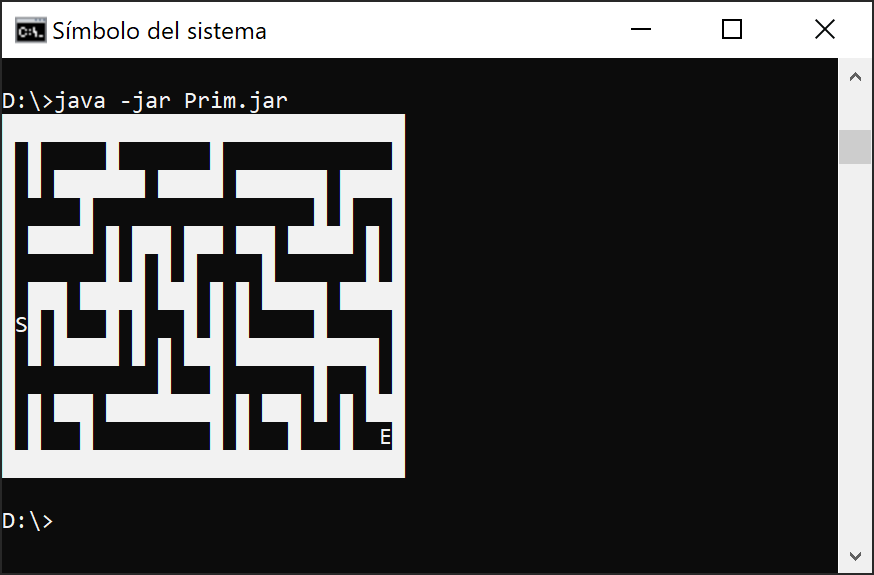
Generación de laberintos I. Algoritmo de Prim's 1.
Autor algoritmo: J. Zong en "Maze Generation with Prim's Algorithm"
Código (Prim.java):
package prim;
import java.util.ArrayList;
public class Prim {
public static void main(String[] args) { // dimensions of generated maze
int r = 13, c = 31;
// build maze and initialize with only walls
StringBuilder s = new StringBuilder(c);
for (int x = 0; x < c; x++) {
s.append('█');
}
char[][] maz = new char[r][c];
for (int x = 0; x < r; x++) {
maz[x] = s.toString().toCharArray();
}
// select random point and open as start node
Point st = new Point((int) (Math.random() * r), (int) (Math.random() * c), null);
maz[st.r][st.c] = 'S';
// iterate through direct neighbors of node
ArrayList< Point> frontier = new ArrayList< Point>();
for (int x = -1; x <= 1; x++) {
for (int y = -1; y <= 1; y++) {
if (x == 0 && y == 0 || x != 0 && y != 0) {
continue;
}
try {
if (maz[st.r + x][st.c + y] == ' ') {
continue;
}
} catch (Exception e) { // ignore ArrayIndexOutOfBounds
continue;
}
// add eligible points to frontier
frontier.add(new Point(st.r + x, st.c + y, st));
}
}
Point last = null;
while (!frontier.isEmpty()) {
// pick current node at random
Point cu = frontier.remove((int) (Math.random() * frontier.size()));
Point op = cu.opposite();
try {
// if both node and its opposite are walls
if (maz[cu.r][cu.c] == '█' && maz[op.r][op.c] == '█') {
// open path between the nodes
maz[cu.r][cu.c] = ' ';
maz[op.r][op.c] = ' ';
// store last node in order to mark it later
last = op;
// iterate through direct neighbors of node, same as earlier
for (int x = -1; x <= 1; x++) {
for (int y = -1; y <= 1; y++) {
if (x == 0 && y == 0 || x != 0 && y != 0) {
continue;
}
try {
if (maz[op.r + x][op.c + y] == ' ') {
continue;
}
} catch (Exception e) {
continue;
}
frontier.add(new Point(op.r + x, op.c + y, op));
}
}
}
} catch (Exception e) { // ignore NullPointer and ArrayIndexOutOfBounds
}
// if algorithm has resolved, mark end node
if (frontier.isEmpty()) {
maz[last.r][last.c] = 'E';
}
}
// print final maze
for (int i = 0; i < r; i++) {
for (int j = 0; j < c; j++) {
System.out.print(maz[i][j]);
}
System.out.println();
}
}
static class Point {
Integer r;
Integer c;
Point parent;
public Point(int x, int y, Point p) {
r = x;
c = y;
parent = p;
}
// compute opposite node given that it is in the other direction from the parent
public Point opposite() {
if (this.r.compareTo(parent.r) != 0) {
return new Point(this.r + this.r.compareTo(parent.r), this.c, this);
}
if (this.c.compareTo(parent.c) != 0) {
return new Point(this.r, this.c + this.c.compareTo(parent.c), this);
}
return null;
}
}
}
Resultado:
miércoles, 10 de agosto de 2022
Distancia entre 2 puntos en un espacio n-dimensional.
Fórmula:
d(P,Q) = SQRT[ (Q1-P1)^2 + (Q2-P2)^2 + (Q3-P3)^2 + ... + (Qn-Pn)^2 ]
Código java (Distancia2p.java)
package distancia2p;
import java.util.Arrays;
public class Distancia2p {
public static void main(String[] args) {
int n = 6; //numero de dimensiones
int[] A = new int[n];
int[] B = new int[n];
//posición cartesiana n coordenadas
int maximo = 100;
int minimo = 1;
for (int i = 0; i < n; i++) {
//numero aleatoria entre 1 (minimo) y 100 (maximo)
A[i] = (int) Math.floor(Math.random() * (maximo - minimo + 1)) + minimo;
B[i] = (int) Math.floor(Math.random() * (maximo - minimo + 1)) + minimo;
}
double aux = 0;
double distancia;
for (int i = 0; i < n; i++) {
aux = aux + Math.pow((A[i] - B[i]), 2);
}
distancia = Math.sqrt(aux);
//mostrar resultados
System.out.println("*Distancia entre 2 puntos en un espacio de " + n + "-dimensiones:");
System.out.println("coordenadas punto A: " + Arrays.toString(A));
System.out.println("coordenadas punto B: " + Arrays.toString(B));
System.out.println("Distancia entre punto A y B: " + distancia);
}
}
Resultado:
run:
*Distancia entre 2 puntos en un espacio de 6-dimensiones:
coordenadas punto A: [29, 89, 69, 33, 18, 22]
coordenadas punto B: [76, 93, 41, 53, 43, 91]
Distancia entre punto A y B: 93.78166132032425
BUILD SUCCESSFUL (total time: 0 seconds)
miércoles, 3 de agosto de 2022
Gráficos 2D. Creación de un fractal 2 (árbol).
Código 1: (Blogspot_Fractal.java):
package blogspot_fractal;
import java.awt.Graphics2D;
import java.awt.image.BufferedImage;
import java.io.File;
import java.io.IOException;
import javax.imageio.ImageIO;
public class Blogspot_Fractal {
public static void main(String[] args) {
int x = 300;
int y = 256;
int angulo = -90;
int depth = 9;
BufferedImage imagen = new BufferedImage(x, y, BufferedImage.TYPE_INT_RGB);
Dibujo.Dibujar((Graphics2D) imagen.getGraphics(), x / 2, y, angulo, depth);
try {
ImageIO.write(imagen, "png", new File("Arbol.png"));
} catch (IOException e) {
System.out.println("Error de escritura");
}
}
}
Código 2: (Dibujo.java):
package blogspot_fractal;
import java.awt.BasicStroke;
import java.awt.Color;
import java.awt.Graphics2D;
import java.awt.RenderingHints;
class Dibujo {
public static void Dibujar(Graphics2D g, int x1, int y1, double angle, int depth) {
if (depth == 0) {
return;
}
g.setColor(Color.GREEN);
// grosor rama dependiendo de la profundidad
g.setStroke(new BasicStroke((float) depth));
//Filtro antialiasing
g.setRenderingHint(
RenderingHints.KEY_ANTIALIASING,
RenderingHints.VALUE_ANTIALIAS_ON);
int x2 = x1 + (int) (Math.cos(Math.toRadians(angle)) * depth * 5.0);
int y2 = y1 + (int) (Math.sin(Math.toRadians(angle)) * depth * 6.0);
g.drawLine(x1, y1, x2, y2);
Dibujar(g, x2, y2, angle - 30, depth - 1);
Dibujar(g, x2, y2, angle + 30, depth - 1);
}
}
Resultado:
martes, 2 de agosto de 2022
Graficos 2D. Curva de Hilbert 2 (4K)
Código 1: (Blogspot_Curvahilbert.java)
package blogspot_curvahilbert;
import java.awt.Graphics2D;
import java.awt.image.BufferedImage;
import java.io.File;
import java.io.IOException;
import javax.imageio.ImageIO;
public class Blogspot_CurvaHilbert {
public static void main(String[] args) {
// resolucion 4K
int x = 2160;
int y = 2160;
int depth = 8;
BufferedImage imagen = new BufferedImage(x, y, BufferedImage.TYPE_INT_RGB);
Dibujo.Dibujar((Graphics2D) imagen.getGraphics(), x / 2, y / 2, depth, y / 2);
try {
ImageIO.write(imagen, "png", new File("CurbaHilbert.png"));
} catch (IOException e) {
System.out.println("Error de escritura");
}
}
}
Código 2: (Dibujo.java):
package blogspot_curvahilbert;
import java.awt.Color;
import java.awt.Graphics2D;
class Dibujo {
public static void Dibujar(Graphics2D g, int x, int y, int n, int size) {
if (n == 0) {
return;
}
int x0 = x - size / 2;
int x1 = x + size / 2;
int y0 = y - size / 2;
int y1 = y + size / 2;
g.setColor(Color.GREEN);
g.drawLine(x0, y0, x0, y1);
g.drawLine(x1, y0, x1, y1);
g.drawLine(x0, y, x1, y);
Dibujar(g, x0, y0, n - 1, size / 2);
Dibujar(g, x0, y1, n - 1, size / 2);
Dibujar(g, x1, y0, n - 1, size / 2);
Dibujar(g, x1, y1, n - 1, size / 2);
}
}
Resultado:

.png)